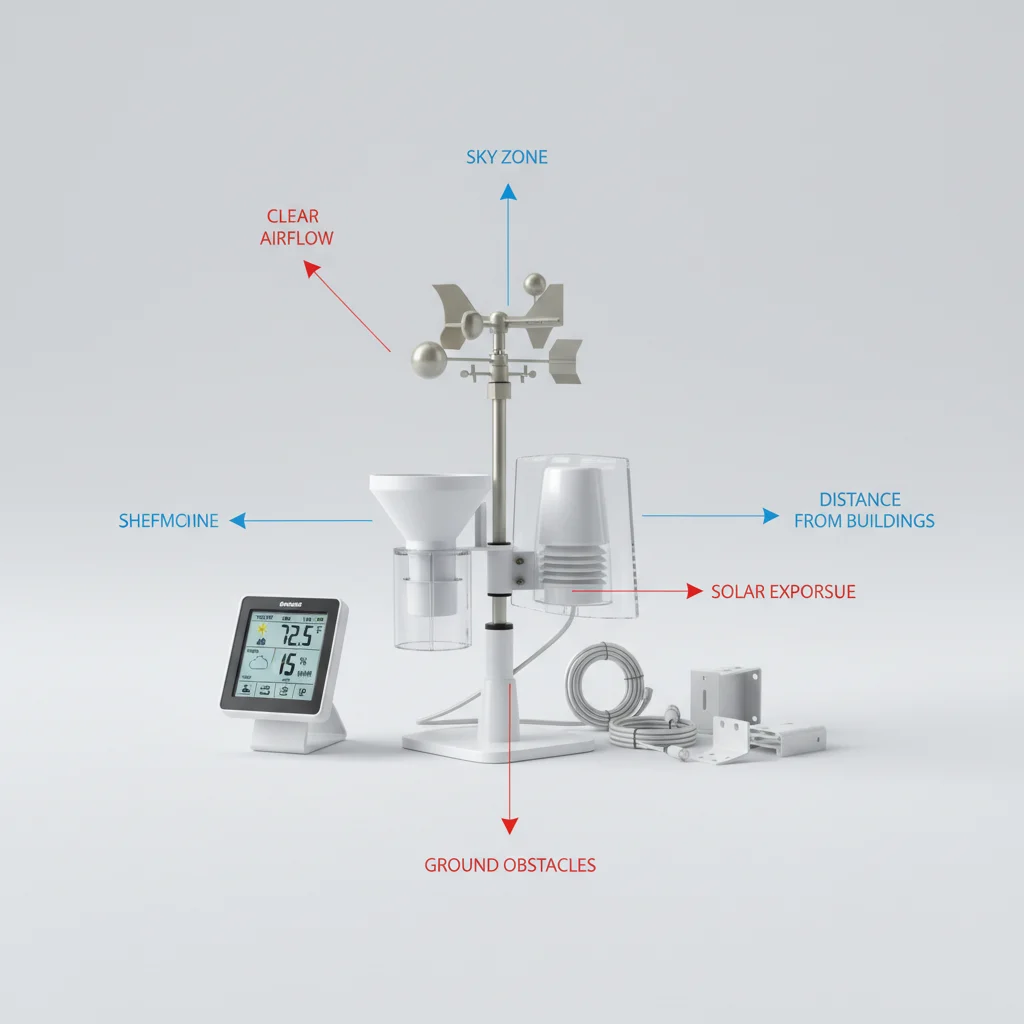
Optimal weather station placement is crucial for achieving accurate readings and reliable local forecasts. There are five key factors to consider when deciding where to install your home weather station, ensuring it captures the most representative data for your specific location. Proper siting avoids common errors that can skew temperature, wind, and precipitation measurements, providing you with trustworthy environmental insights.
Understanding Wind Sensor Requirements
Wind speed and direction sensors, typically an anemometer and wind vane, require an unobstructed path to accurately measure airflow. The general recommendation is to place these sensors at least 33 feet (10 meters) above the ground and at least 7 feet (2 meters) above the nearest obstruction. This height helps to minimize the impact of turbulence caused by buildings, trees, and other structures. Consider the prevailing wind direction in your area and position the sensor to face this direction with the fewest obstacles. Any nearby structures can create wind shadows or accelerate wind, leading to inaccurate readings. For most residential setups, mounting on a mast attached to the roof or a dedicated pole in an open area is ideal.
Temperature and Humidity Sensor Siting
Temperature and humidity sensors are highly sensitive to direct sunlight and radiated heat. To ensure accurate readings, these sensors should be placed in a shaded, well-ventilated area, typically 4 to 6 feet (1.2 to 1.8 meters) above the ground. Avoid placing them near heat-radiating surfaces like asphalt driveways, concrete patios, or building walls, as these can artificially inflate temperature readings. Similarly, proximity to air conditioning units, dryer vents, or exhaust fans will compromise accuracy. A Stevenson screen or a similar radiation shield is essential for protecting these sensors from solar radiation while allowing for natural airflow. Many integrated weather stations come with these shields built-in.
Rain Gauge Installation Best Practices
|
Our Picks for the Best Weather Station in 2026
As an Amazon Associate I earn from qualifying purchases.
|
||
| Num | Product | Action |
|---|---|---|
| 1 | Ambient Weather WS-2000 Smart Weather Station with WiFi Remote Monitoring and Alerts |

|
| 2 | Tempest Weather Station with Built-in Wind Meter, Rain Gauge, and Accurate Weather Forecasts, Wireless, App and Alexa Enabled |
|
| 3 | Sainlogic Smart WiFi Weather Station with 24H/7Days Accurate Weather Forecast by Weatherseed® AI, 8.5" Large Display,UV,Sun Light,Rain Gauge,Wind Gauge,2-Year Data Storage & Export, Only 2.4G |
|
| 4 | 10-in-1 Wireless Weather Station,with Outdoor Sensor,Rain Gauge,Atomic Clock,Wind Speed/Wind Direction,Indoor Temperature and Humidity,Barometer,Weather Forecast, etc.(NO WiFi) |
|
| 5 | Sainlogic WiFi Smart Weather Station SA9 with 24H/ 7Days Accurate Weather Forecast by Weatherseed® AI, 8.5" Large Display,UV,Sun Light,Rain Gauge,Wind Gauge,2-Year Data Storage & Export(Only 2.4G) |
|
| 6 | 14-in-1 Wireless Weather Station with Outdoor Wireless Sensor,Radio-Controlled Clock,Rain Gauge,Wind Speed/Direction,Moon Phase,Wind Chill Index,Outdoor Dew Point,Barometer(NO WiFi) |
|
| 7 | AcuRite Iris (5-in-1) Indoor/Outdoor Wireless Weather Station for Indoor and Outdoor Temperature and Humidity, Wind Speed and Direction, and Rainfall with Digital Display (01512M) |
|
| 8 | Ambient Weather WS-2902 WiFi Smart Weather Station |
|
| 9 | Sainlogic Smart WiFi Weather Stations Wireless Indoor Outdoor SA68 Plus,24/7 AI Weather Forecast by Weatherseed®,APP/Email Alert,Home Weather Station with Rain Gauge,2-Year Data Storage(Only 2.4G) |
|
| 10 | WiFi Weather Station Wireless Indoor Outdoor, Thermometer with Rain Gauge and Wind Speed/Direction, Large Display for Weather Forecast, Temperature, Humidity, Clock, Alarm, UV, Air Pressure, Black |
|
Accurate precipitation measurement depends heavily on the rain gauge’s placement. The gauge should be installed on a level surface, away from any overhead obstructions such as trees, eaves, or fences that could block rainfall or cause splash-in. A good rule of thumb is to ensure the distance from any obstruction is at least twice the height of the obstruction. For example, if a tree is 10 feet tall, the rain gauge should be at least 20 feet away. The top of the rain gauge should be about 2 to 5 feet (0.6 to 1.5 meters) above the ground to prevent splash-out from the ground and minimize interference from ground-level debris. Regularly check the gauge for leaves, twigs, or insect nests that could impede its function.
Solar Radiation and UV Sensor Considerations
For weather stations equipped with solar radiation or UV sensors, unobstructed exposure to the sun is paramount. These sensors should be mounted in a location that receives direct sunlight throughout the day, from sunrise to sunset, without any shadows cast by buildings, trees, or other structures. They are typically integrated into the main sensor array, so ensuring the entire array has clear sky visibility is important. Avoid locations where dust or debris could accumulate on the sensor surface, as this can reduce accuracy. Regular cleaning of the sensor surface is recommended to maintain optimal performance.
Optimal Barometric Pressure Sensor Location
Unlike external sensors, the barometric pressure sensor is often located within the indoor console of your weather station. While its placement is less critical in terms of outdoor environmental factors, it’s still important to consider a few points. The console should be placed in a stable indoor environment, away from direct sunlight, drafts, or significant temperature fluctuations that could affect the internal electronics. For the most accurate local pressure readings, you may need to calibrate the sensor to your specific altitude. Most modern weather stations allow for this adjustment, which is crucial for obtaining true sea-level pressure or station pressure. Consult your weather station’s manual for specific calibration instructions.
- Ensure clear line of sight for wind sensors.
- Shade temperature/humidity sensors from direct sun.
- Place rain gauge on level ground, away from obstructions.
- Mount solar/UV sensors for full sun exposure.
- Calibrate indoor pressure sensor to local altitude.
By carefully considering these five factors, you can significantly improve the accuracy and reliability of your home weather station’s data. Proper placement not only enhances the quality of your personal weather observations but also contributes to more precise local forecasting. Investing time in optimal setup will pay off with years of dependable weather information.
Frequently Asked Questions
How high should a wind sensor be placed for accurate readings?
Wind sensors, including anemometers and wind vanes, should be placed at least 33 feet (10 meters) above the ground and 7 feet (2 meters) above any nearby obstructions. This height minimizes turbulence from buildings and trees, ensuring more accurate airflow measurements.
Where is the best location for temperature and humidity sensors?
Temperature and humidity sensors should be placed in a shaded, well-ventilated area, typically 4 to 6 feet (1.2 to 1.8 meters) above the ground. Avoid heat-radiating surfaces like asphalt or concrete, and use a Stevenson screen for protection from direct sunlight.
What are the best practices for installing a rain gauge?
A rain gauge should be installed on a level surface, 2 to 5 feet (0.6 to 1.5 meters) above the ground, and away from overhead obstructions. The distance from any obstruction should be at least twice the obstruction's height to prevent blocked rainfall or splash-in.
How do I ensure accurate readings from solar radiation and UV sensors?
Solar radiation and UV sensors require unobstructed exposure to direct sunlight throughout the day, from sunrise to sunset. Mount them in a location free from shadows cast by buildings or trees, and regularly clean the sensor surface to prevent dust accumulation.
Where should the barometric pressure sensor be located for optimal accuracy?
The barometric pressure sensor is typically inside the indoor console, which should be placed in a stable indoor environment away from direct sunlight or drafts. For the most accurate local pressure, calibrate the sensor to your specific altitude using your weather station's manual.
How to Optimize Home Weather Station Placement
Achieve accurate weather data by correctly positioning your home weather station's sensors.
Place wind speed and direction sensors at least 33 feet (10 meters) above the ground and 7 feet (2 meters) above the nearest obstruction. This minimizes turbulence and ensures accurate airflow measurements.
Install temperature and humidity sensors in a shaded, well-ventilated area, typically 4 to 6 feet (1.2 to 1.8 meters) above ground. Avoid heat-radiating surfaces and use a radiation shield.
Mount the rain gauge on a level surface, 2 to 5 feet (0.6 to 1.5 meters) above the ground, ensuring it's away from any overhead obstructions. The distance from obstructions should be at least twice their height.
Place solar radiation and UV sensors in a location that receives direct sunlight throughout the entire day. Regularly clean the sensor surface to maintain optimal performance and accuracy.
Position the indoor console with the barometric pressure sensor in a stable environment. Calibrate the sensor to your specific altitude for the most accurate local pressure readings, consulting your weather station's manual.

I just installed a new home weather station and was feeling a bit overwhelmed with where to put everything. The breakdown of how to get accurate precipitation measurements was exactly what I needed. I made sure my rain gauge is in an open area, away from anything that could block or funnel rain, and it seems to be working perfectly.
Good info overall, especially about avoiding obstructions. My main issue is that the 7 feet above the nearest obstruction rule is really hard to achieve in my backyard. I have a lot of trees and it’s tough to find a spot that high without being too far from my house for the signal. Still, it gave me some ideas to improve.
I’ve been struggling with inconsistent wind readings for ages, and the tip about placing the anemometer at least 33 feet up was a game-changer. I finally got my wind sensor above the tree line and the data is so much more reliable now. Wish I’d known this sooner, it really makes a difference for my local forecasts.
This was super helpful for fine-tuning my weather station setup. I thought I had good placement, but realizing how much buildings can affect temperature readings made me rethink my sensor’s spot. Moved it further from the house and the temps are much more consistent with what I’m seeing outside. Great advice!